The Cost of Staying at the Frontier
Anthropic’s scaling thesis connects the next generation of models to the next generation of infrastructure. Its S-1 shows how much depends on that relationship enduring.
Mikey & Colin
Co-Founders

In our last article, “AI’s Biggest Constraint Is Its Biggest Investment Opportunity,” we looked at the physical infrastructure behind Anthropic’s growth: computing capacity, electricity, and data centres that take far longer to build than software takes to change. The filing made the investment opportunity unusually tangible. This week, we want to follow the argument back to the research that makes so much of that spending intelligible.
Near the beginning of Anthropic’s October 26 S-1, immediately after the securities pages, a short passage explains the company’s conviction. “In 2020, four of our founders co-wrote a paper that documented the scaling laws of AI.” It then describes how increasing compute, data, model size, and training environments together produces improvements in general cognitive capabilities and economic value.
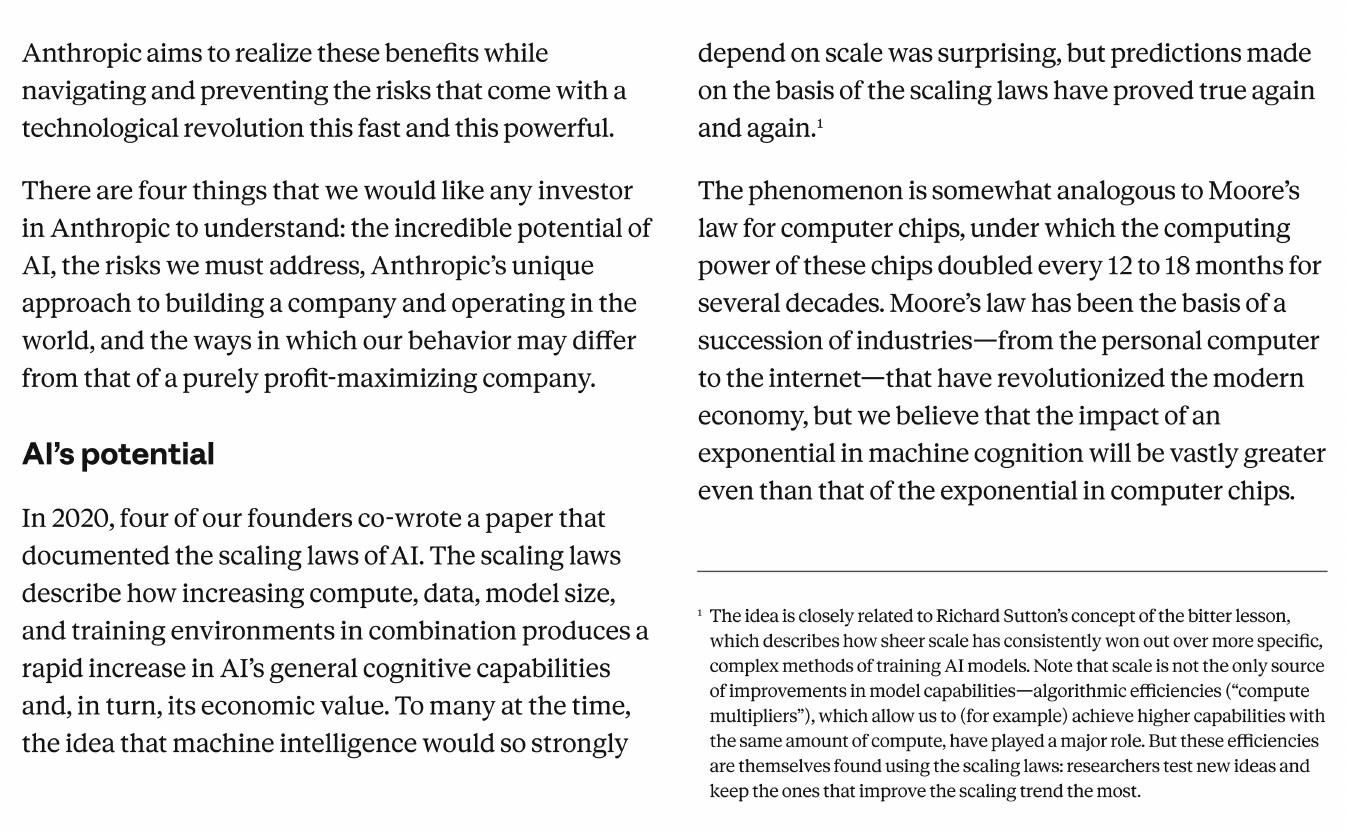
There is a considerable business thesis inside those sentences. If greater training resources can reliably produce more capable models, access to compute helps determine what a lab can build next. If customers increasingly entrust valuable work to the strongest models, that same access helps determine how much business the lab can win. Anthropic’s infrastructure requirements begin with a scientific observation and extend into its competitive position, financing needs, and long-term commitments.
The important word is “together.” More computing power creates room to train larger models on more useful experience. The gains depend on how effectively those resources are combined. Buying additional chips provides an opportunity to improve intelligence; research and execution determine how much of that opportunity becomes real.
How a research observation became a strategy
The idea has a longer history than Anthropic. In 2017, Joel Hestness and colleagues at Baidu Research documented predictable improvements as training datasets expanded across language, translation, images, and speech. Their paper, “Deep Learning Scaling is Predictable, Empirically,” showed that this regularity extended across several kinds of model. Researchers were beginning to find a common pattern beneath very different applications.
https://arxiv.org/abs/1712.00409
Dario Amodei’s own conviction developed through practical experiments. In his 2023 interview with Dwarkesh Patel, he traced it to work between 2014 and 2017, beginning with speech recognition at Baidu. Adding data, enlarging networks, and extending training produced consistent improvements. At OpenAI, the implications became broader: a system trained on language could acquire useful abilities across many tasks without a separate architecture for each one.
GPT-2 offered an early demonstration in 2019. Trained to predict what came next in text, it displayed rudimentary translation, comprehension, and summarization without task-specific training. GPT-3, described in 2020, extended that approach to a 175-billion-parameter model that could perform numerous tasks from instructions or a few examples supplied in its input. The results were uneven, but the breadth was consequential. A general training process was producing increasingly general usefulness.
The 2020 paper “Scaling Laws for Neural Language Models” gave this direction a quantitative framework. Jared Kaplan and Sam McCandlish led the research; Tom Brown, Dario Amodei, and other OpenAI researchers were co-authors. Those four later co-founded Anthropic. The paper’s contribution was to measure how language-model performance changed with model size, training data, and computation, making it possible to estimate the returns to a larger training budget before committing it.
https://arxiv.org/abs/2001.08361
That predictability matters enormously when experiments become expensive. A lab can train smaller systems, measure the relationship between resources and performance, and use those observations to plan a much larger run. Forecasts remain fallible. They nevertheless give a research programme a degree of financial legibility that a succession of isolated breakthroughs would lack.
Why more training can produce more capability
A language model begins with adjustable numerical values called parameters. During training, it processes text broken into small units called tokens, predicts the next token, and changes its parameters to make better predictions. The calculation is repeated across an enormous range of examples. Compute is the arithmetic required to make those predictions and work backwards through the model to adjust its values.
Accurate prediction across varied text demands more than familiar phrasing. Completing a programming example can require tracking variables. Following a legal argument can require recognizing an exception introduced several paragraphs earlier. A mathematical explanation can depend on relationships that ordinary word associations cannot adequately capture. Training gives a sufficiently capable model an incentive to learn reusable patterns underlying these examples, although it can also reward shallow shortcuts and memorization.
Larger models have more capacity to represent those relationships. Diverse, high-quality data provides evidence from which to learn them. More computation allows the training process to bring capacity and experience together. Generalization is the resulting ability to handle examples beyond those seen in training. The empirical record shows that scaling can improve it, while leaving substantial gaps in reliability and unfamiliar situations.
Researchers summarize prediction quality with a number called loss, which penalizes the model when it assigns too little probability to the token that actually follows. Lower loss on held-out text means better prediction on material excluded from training. Kaplan and colleagues found that loss improved along smooth power-law curves over wide ranges of resources. Broadly, multiplying the available compute by a given amount produced a fairly regular proportional improvement in the measured loss within the regime studied.
These curves already contain diminishing returns. Each additional unit of compute tends to buy less improvement than the last. Continued progress therefore demands increasingly large resource increases, unless better algorithms or data make the process more efficient. The capital intensity follows naturally from this arithmetic, even when the research continues to work.
A useful approximation for dense transformer training is C ≈ 6ND: total computation is roughly six times the number of model parameters, N, multiplied by the number of training tokens processed, D. The factor reflects the main arithmetic of prediction and parameter adjustment. It leaves out important implementation details and becomes less representative for some architectures and long contexts. Even so, its implication is clear: doubling both model size and training tokens requires roughly four times the computation under these assumptions.
In 2022, Jordan Hoffmann and colleagues at DeepMind revisited that trade-off in the Chinchilla paper. Their experiments suggested that model size and training tokens should grow in approximately equal proportions for training-compute-optimal performance. Chinchilla, with 70 billion parameters and 1.4 trillion training tokens, outperformed the 280-billion-parameter Gopher using the same training compute budget. A better balance delivered a better model with fewer parameters.
https://arxiv.org/abs/2203.15556
This also complicates the idea that the best model must always be the largest. A laboratory may train a smaller model for longer because lower serving costs justify additional training expenditure. Architectures that activate only part of a model for each token create further distinctions between total parameters and actual arithmetic. Compute remains central, but parameter count alone is an incomplete measure of either intelligence or cost.
There is another limit to prediction. Loss averages performance across a broad distribution of text; customers care about particular accomplishments. A modest statistical improvement may help a model cross the threshold from generating plausible code to completing a useful task, while another capability barely changes. In his Patel interview, Amodei described the uncertainty plainly: “What’s predictable is this statistical average,” while specific abilities are much harder to anticipate. Scaling offers a comparatively dependable direction of progress, with much less certainty about the timing of individual abilities.
https://www.dwarkesh.com/p/dario-amodei
The financial consequences of believing it
Anthropic’s risk factors connect that research directly to revenue. On printed page 27, the company says its success depends substantially on continuing to develop the most advanced and capable models. On page 31, the warning becomes sharper: “even a brief period without access to sufficient compute could cause us to fall behind quickly.” Customers and developers may move to competitors, while inadequate research resources can make technical talent harder to retain.
The danger can compound. Page 28 describes how weaker growth could constrain investment, which could further weaken the company’s ability to compete and grow. Under Anthropic’s thesis, compute supports the next generation of products that supports the next generation of revenue. Cutting investment may protect near-term cash while damaging the capabilities needed to replenish it.
That helps explain the prominence of compute throughout the S-1. Training capacity supports future competitiveness, while inference capacity, the computing used to run trained models for customers, supports current demand. Anthropic describes managing these uses as a shared resource. Allocating more capacity to research has an opportunity cost when customers are waiting; prioritizing today’s usage can have one when a competitor is preparing a stronger model.
The timing makes the choice harder. On printed page 134, Anthropic says it typically procures its multi-year committed compute 12 to 18 months before availability. Page 31 acknowledges that it has previously significantly underestimated its requirements. The company must therefore reserve infrastructure before knowing precisely which training methods will prove most effective or how much demand future capabilities will create.
For investors, the relevant exposure includes the terms of those reservations. Minimum purchases and take-or-pay provisions can turn uncertain requirements into binding cash obligations. Anthropic also describes moving toward a hybrid arrangement involving directly leased chips and dedicated facilities. Some infrastructure investment sits with suppliers, some obligations sit with Anthropic, and accounting treatment varies. A compute commitment should not automatically be treated as immediate capital expenditure, or as the cost of training one model.
The underlying risk is a mismatch between long-lived obligations and rapidly changing technology. Too little capacity can weaken research and constrain sales. Too much, or the wrong hardware arriving at the wrong time, can leave expensive resources underused. A forecast can be broadly correct about AI’s future and still produce a disappointing investment if its timing, financing, or contractual terms are wrong.
Where does this leave us?
The strongest objection is that empirical regularities can stop being useful outside the conditions in which they were measured. We have quantitative scaling relationships, but no universal proof that the same curves must extend indefinitely. Asked why scaling works, Amodei told Patel: “I think the truth is that we still don’t know.” Plausible explanations involve learning progressively rarer and more subtle patterns. A complete account of why the curves are so smooth remains elusive.
Data is a serious constraint. An Epoch research paper projected that, if historical trends continued, training datasets could approach the available stock of public human-generated text between 2026 and 2032. That was a conditional forecast, rather than evidence that useful data has already disappeared. Synthetic examples, new modalities, and learning from verified outcomes offer alternatives, with their own limits. Generating more text is easier than generating more trustworthy information.
The slowdown debate also predates this filing. Reuters reported concerns about pretraining progress in November 2024, alongside efforts to improve models through additional computation while answering. OpenAI’s o1 research that September showed gains from both more reinforcement-learning training and more test-time computation. These are distinct mechanisms: one changes the trained model; the other lets it spend more resources working through a particular problem. Their success does not establish that the original pretraining curves will hold unchanged.
Our view is that continued returns to well-directed compute remain the stronger working assumption. The evidence spans multiple research programmes and domains, while Chinchilla shows how revising the allocation can extend progress. Richard Sutton’s “The Bitter Lesson” offers the broader historical argument that general methods able to exploit growing computation tend to prevail. Anthropic’s introductory footnote explicitly acknowledges algorithmic efficiencies alongside scale.
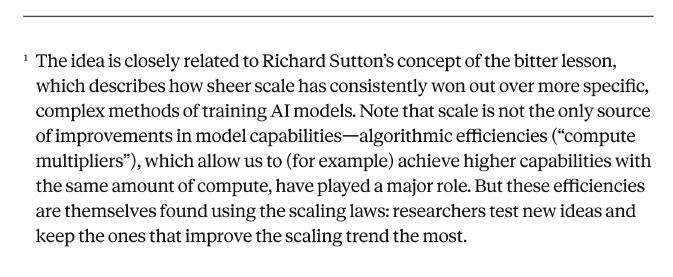
That supports conviction with conditions attached. Curves can bend, data can become harder to obtain, and particular approaches can exhaust their usefulness. Better training methods may reduce the compute needed for a fixed capability even as the frontier advances. The economically important question is whether the next improvement creates enough additional value to justify pursuing it. A measurable gain in prediction quality does not settle that question.
Last week, we argued that supplying AI’s physical requirements could create enduring investment opportunities. Scaling gives that argument a deeper foundation, while sharpening the need for discipline. Training demands tightly coordinated computing systems; a collection of available chips in disconnected locations cannot necessarily substitute for a working cluster. Power, networking, cooling, and reliable delivery affect how much purchased capacity becomes productive research.
The world will need more compute, across training and deployment, even as it learns to use each unit better. For Anthropic, staying at the frontier means continually converting research conviction into infrastructure commitments, then converting those commitments into capabilities customers will pay for. For investors, the opportunity is to identify the businesses that make that conversion faster, cheaper, and more dependable.


